

How To Read A Sewing Pattern
Uh oh. You just bought a pattern, only to open it and become lost in all sorts of complicated markings, symbols, and instructions that look like a foreign language. While it may look scary at first, patterns are ultimately just a set of instructions that follow a simple system. Once you learn how to read them, patterns become a lot easier to understand, and you’ll be able to tackle them with confidence. In this blog, I will explain what a pattern is, why you should use one, and share some extremely important details about patterns.
What is a pattern, and why should I use one?
Both beginners and experienced sewers use patterns, as they provide an excellent guide to sewing anything from simple pillowcases to detailed dresses. If you don’t want to guess how to sew something, patterns are fantastic for providing clear instructions to do so. But at the end of the day, do you always need to use one? No. Patterns are a great way for beginners to gain confidence and to help with more complex patterns, but eventually, many sewists decide to either not use a pattern or to draft their own. Using patterns isn’t required or forbidden - it ultimately depends on your sewing level, the complexity of your project, and your personal preferences.
What kinds of patterns are there?
There are two kinds of patterns: paper and PDF patterns. Paper patterns can be bought online or in-store and come with one large sheet containing one copy of each pattern piece. PDF patterns are bought online (they are sometimes free) and downloaded to be printed. PDF patterns can be reprinted as long as you keep the download, which helps if you need to cut out the patterns more than once.
All patterns include:
Instructions
Pattern sheets
Sizing guides
How to start:
Consult the sizing guide. Each pattern contains a sizing guide with measurements such as bust, waist, and hips, which help you find your size for the pattern.
Look at the recommended fabrics for the piece. Most patterns contain a fabric guide, stating what fabrics are recommended for the pattern.
Consult the instruction guide. Familiarize yourself with the instructions so you can sew to the best of your ability!
Understand the pattern pieces and how they need to be laid out. Each pattern piece says things such as “Cut two” or “Place on fold”. These are instructions for using the pattern and laying it out on your fabric.
Things to keep track of:
Seam allowance: The extra fabric between the edge of the fabric and a stitched line holding pieces of fabric together. Seam allowance ensures that a garment can be adjusted more comfortably and that stitches can be sewn more easily without tearing.
Grainline: The way a pattern is laid out compared to the grainline of a fabric can make the pattern more or less stretchy. To learn more about grainline, read last week’s blog here!
Notches: Notches are important to patterns in three main ways:
Front VS Back: In patterns, one notch normally means the front of a garment, whereas two notches mean the back of a garment. Notches line up, and these indications help distinguish a front pattern from a back pattern.
Gathering: When sewing a larger piece of fabric to a smaller piece, lining up the notches is crucial. Once lined up, extra fabric remains on one piece. This fabric then needs to be gathered. Notches are so helpful in these scenarios because they eliminate guesswork.
Details: Sometimes, notches can mark where details such as zippers, buttons, darts, pockets, and more belong on a pattern.
Markings: Patterns have all sorts of markings, such as darts, button placements, pleats, and more.
Darts: Lines forming triangles in the pattern to allow for a garment to have a more flattering fit.
Button placements: Small circles on the pattern that show where buttons (and buttonholes) can be placed.
Pleats: Shown with dotted lines or arrows; pleat markings signal where to fold the fabric to create pleats. The arrow indicates the direction of the pleats.
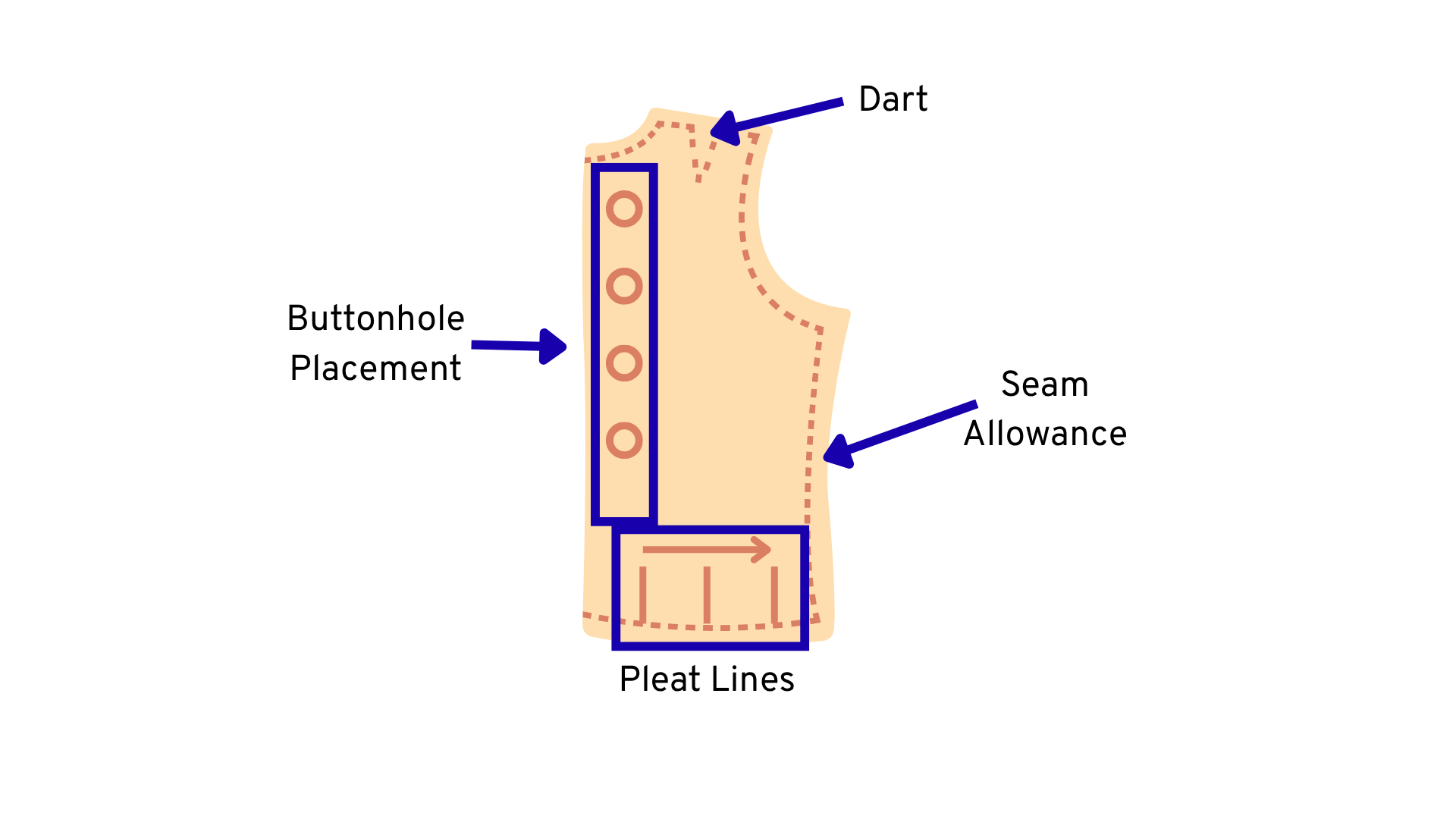
Diagram Displaying the Placement of Buttonholes, Darts, Seam Allowance, and Pleat Lines in a Pattern.