

All About Needles: Part Two
In the last blog, we talked about machine sewing needles (If you haven’t read that post yet, click here!). This week, we’ll explore the other main type of sewing needle: hand-sewing needles. From everyday mending to embroidery, picking the right needle will make all the difference in ensuring a successful project. So, without further ado, let’s get into it!
Sharps Needles - Sharps needles are the perfect choice for general hand-sewing. They’re sharp and thin, making them a great choice for most kinds of hand sewing. Sharps needles work best with tightly woven fabrics because they slice through the threads, whereas looser weaves require needles that slip between the threads.
Beading Needles - Used for projects that require beads to be sewn onto fabric. Their long, thin shape makes them perfect for fitting through beads. Beading needles can also be used for sewing trims or ribbon embroidery.
Betweens/Quilting Needles - Short, sharp needles that enable quick, accurate stitching. These qualities make betweens/quilting needles a popular choice for quilting, applique, or for fine seams and hems.
Tapestry Needles - Some of the thickest and bluntest hand-sewing needles. They are commonly used for stitching open-weave fabric as the point will push fibres to the side, not puncture them. Thinner tapestry needles can be used for cross-stitching, while thicker tapestry needles can be used for weaving yarn into knitted or crocheted fabrics.
Crewel/Embroidery Needles - Much like sharps needles in size, length, and sharpness, but feature a wider eye to accommodate multiple strands of thin threads.
Darning Needles - Used to repair holes in fabric by weaving thread into the damaged fabric; consists of a blunt, sharp, and sometimes angled tip. Darning needles vary in shape, size, and sharpness depending on which fabric is being mended. These needles can also be used for mending knitted and crocheted fabrics.
Now that we know the difference between machine and hand-sewing needles, how can we tell them apart when buying needles? The first step is determining whether a pack of needles is intended for machine or hand sewing. One way of doing so is by looking at the packaging label and the name of the needles (For example, Universal for machine sewing, or Sharps for hand-sewing). Another key aspect is looking at the placement of the eye on the needle. In a machine sewing needle, the eye is located at the pointed end, towards the bottom, while in a hand-sewing needle, the eye is at the top. Below is a comparison of two packs of needles and what to look for when purchasing.
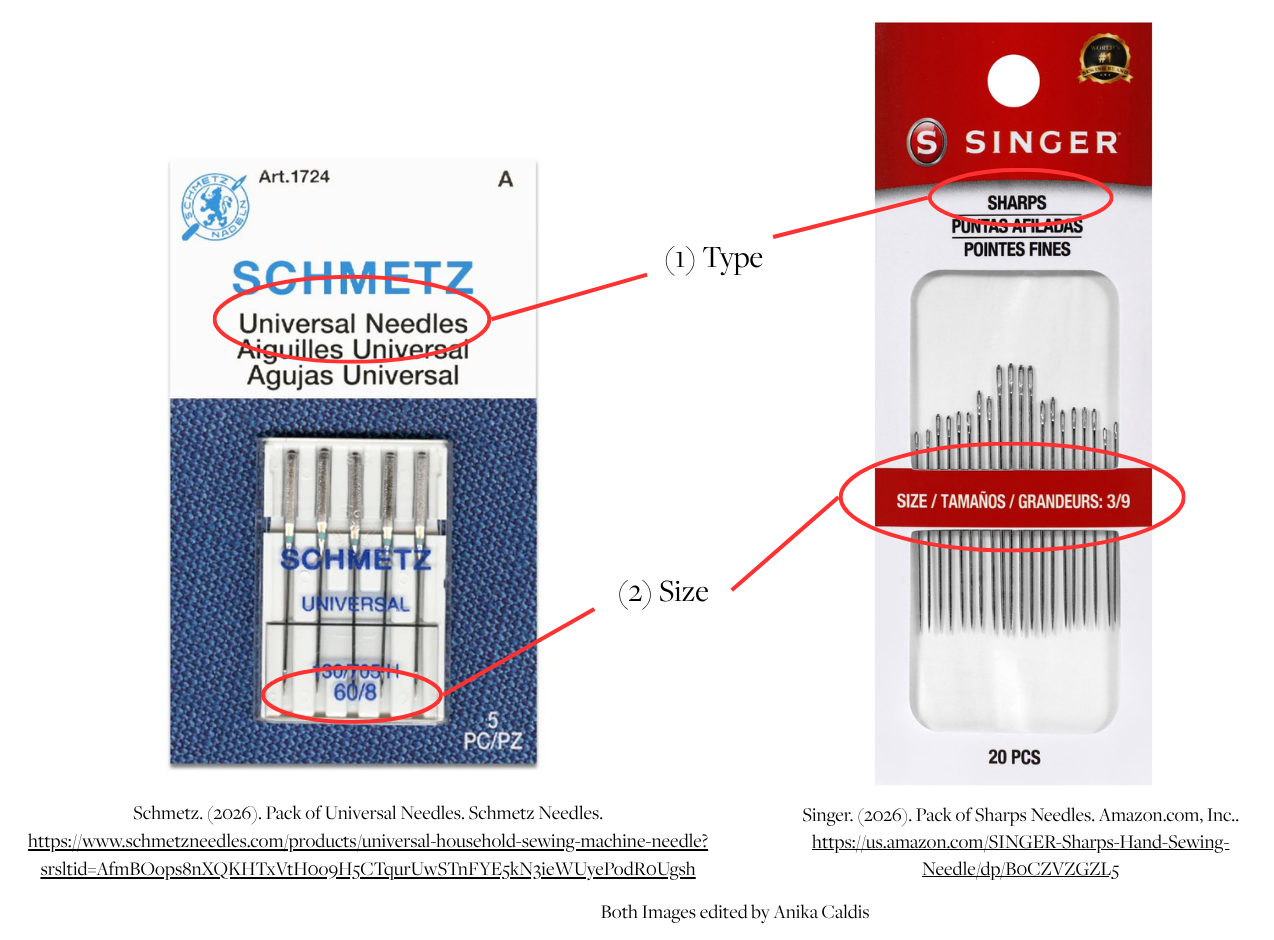
Comparison Between Machine and Hand-Sewing Needles.
Type - The type of needle. This determines whether a pack of needles is for machine or hand-sewing.
Size - Indicates the size of the needle. For machine needles, higher numbers indicate thicker, stronger needles. The first number is the European measurement, which refers to the needle’s diameter in hundredths of a millimeter. For example, an 80 needle would be .80 mm in diameter. The second number is the American measurement, ranging from 8 to 20, where 8 is the smallest and 20 is the largest. Hand-sewing needles use an opposite sizing system: as the number increases, the needle gets smaller. These needles typically range from 1 to 28, where size 1 is the largest and size 28 is the smallest.
Tips for Buying Needles:
Make sure to buy the correct needle for the fabric. Thicker fabrics require stronger needles, while lightweight fabrics should be sewn with thinner needles.
Match the fabric type. Universal needles work for most woven fabrics, but specialty fabrics often require specific needles. For example, ballpoint/stretch needles work best for knit fabrics, and leather needles work best with leather.
Match the needle with the thread’s thickness. Thicker thread requires larger-eye needles and is consequently best used with larger needles.